

Katmai National Park’s brown bears build fat to survive. Stored body fat is the fuel that powers their ability to hibernate during winter. In the den, they don’t eat, drink, urinate, or defecate. As such, they must work hard to eat a year’s worth of food in about six months to survive winter.
Brown bears are omnivores who eat dozens of different plant and animal foods in Katmai. For the Fat Bear Week bears, however, sockeye salmon are especially important. At Brooks River, bears gather to fish for salmon between late June and late October. Bears work hard to take advantage of this bounty before winter arrives.
While every brown bear seeks to satisfy the same basic needs, each bear is unique, adaptable, and intelligent. Success and survival for bears depends on their suite of behaviors, knowledge, and skills to face and overcome hardship.
Bear Families
A mother bear and her cubs overcome many challenges to stay safe and build fat before winter. Mother must feed, nurture, and protect her cubs while working to eat enough calories to sustain herself through months of hibernation. Cubs face risks posed by larger bears and the hazards of the landscape. They also grow fast. A spring (first-year) cub weighs about one pound (0.45 kg) at birth, yet can grow to more than 70 pounds (32 kg) by the end of summer. Yearling (second-year) cubs in Katmai can weigh well over 200 pounds (90.7 kg) by September.
Variations in the salmon run over many years allow us to consider the ways in which food affects a bear population’s reproductive success. The lives of cubs help us understand the vulnerability of young bears and the joys that they experience. The growth and survival of cubs is a direct reflection of a mother bear’s effort, devotion, and commitment. In recognition of the record high number of bear families (19) and cubs (37) at Brooks River in summer 2026, Fat Bear Week includes five bear families.
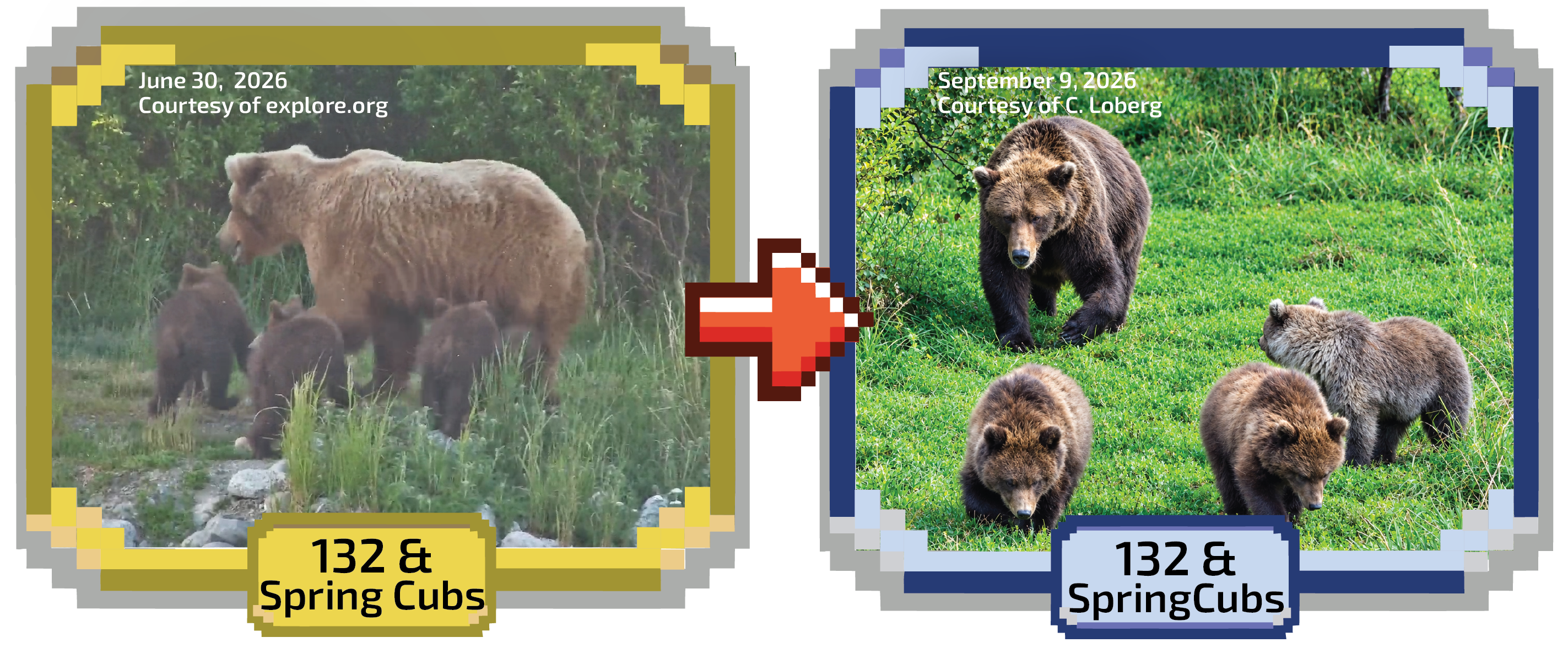
132 and Three Spring Cubs
Identification
This mother is a large adult female with grizzled dark brown fur, forward leaning ears, and a wide belly. Her face is distinguished from other bears by the inverted V or chevron pattern of fur on her forehead.
Biography
Bear 132 was first identified as a 4.5-year-old in 2009. She’s become one of the largest and most experienced mother bears at Brooks River. Her three spring cubs represent her fourth known litter.
In mid-July, one of 132’s cubs went missing from the family. No one witnessed where or how this happened. For several days, the cub wandered the river corridor alone and sometimes approached different bear families only to be ignored or chased away. The longer the cub remained alone, the greater the risk to them.
As an experienced mother with two remaining cubs to care for, 132 continued her efforts to protect and feed them yet her bond with the missing cub remained strong. After several days apart, 132 and her cub reunited in the lower Brooks River area. Perhaps a bit of luck was involved, but maybe the reunion was made more likely because of 132’s experience at Brooks River. She knows the area well and where her cubs are safest. Experience is a significant advantage for mother bears, and 132 showcases it through the survival of her cubs. She is believed to be the mother of 806, another 2026 Fat Bear Week contender. This is her first Fat Bear Week appearance.
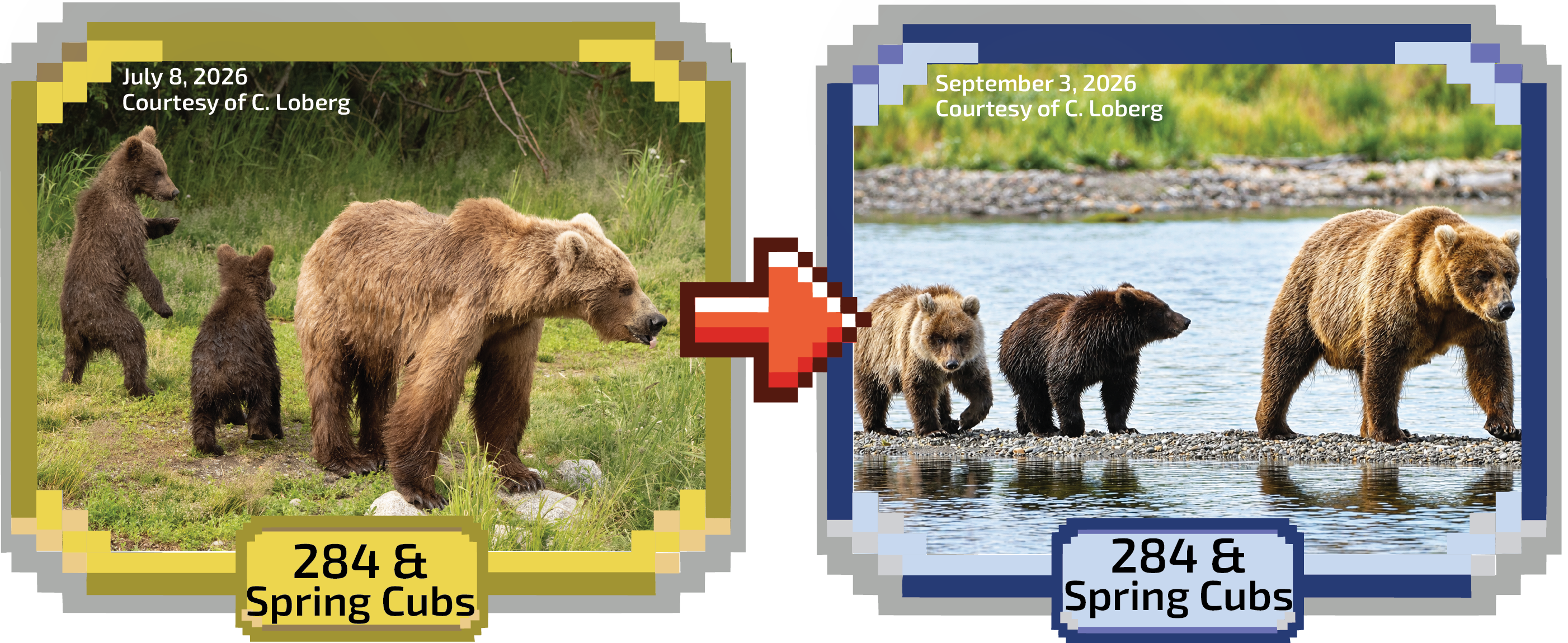
284 And Two spring Cubs
Identification
This mother has a prominent shoulder hump, grizzled brown fur, and blond-tipped ears.
Biography
Bear 284 was born in 2008 and introduced to Brooks River by her mother 708 Amelia. As a cub, 284 was curious and bold, traits that she carried into her subadult years. As a full-grown adult, and especially when she’s raising cubs, 284 is prone to challenge other bears and sometimes people to protect her personal space or offspring.
Now in her late teens, 284 is at an age when mother bears often have their greatest reproductive success. Her lifetime of experience and collective knowledge of her home range combine to give 284 advantages when raising cubs that younger mothers don’t yet have.
Her success, and that of her current litter of cubs, is a continuation of a family legacy. It includes the efforts of her mother, 708 Amelia, to gift 284 with the knowledge and skills to survive on her own. This was a legacy of 708’s introduction to Brooks River by her mother, 438 Reggie. 284’s known offspring, such as 901 and 384, follow bear trails blazed by several maternal generations. In this manner, 284 and her current litter of cubs are part of a greater story. It is a legacy of success and survival.
Watch to learn more about 284 Electra
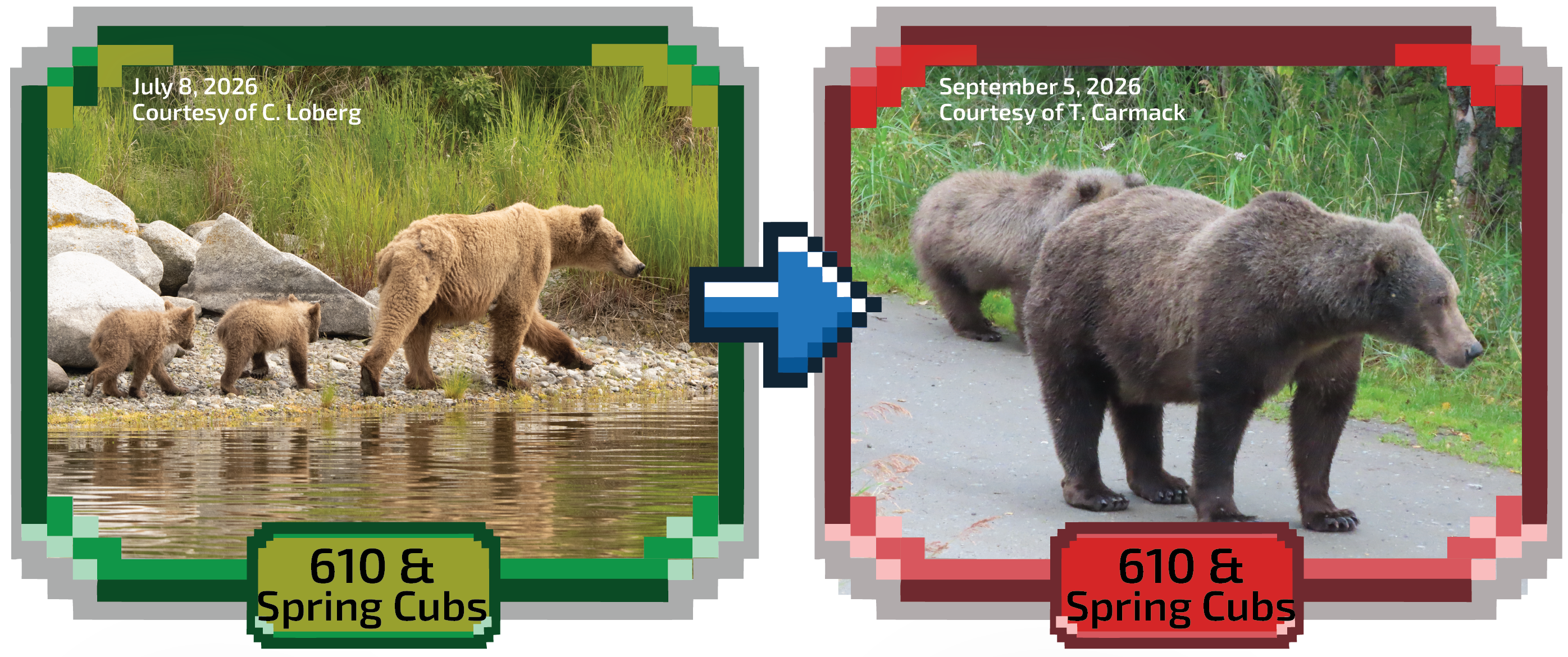
610 and Two Spring Cubs
Identification
This mother is a small adult female with a long muzzle and grizzled light brown fur. A large scar is sometimes visible at the top of her hips.
Biography
Bear 610 began her life of independence earlier than expected. She was so small when she was first identified in the fall of 2015 that many rangers believe that she was a yearling bear. Most bears in Katmai stay with their mothers through two or three summers before family breakup the following spring. A sudden danger or accident may have contributed to 610’s separation from her mother.
Adversity came in other forms for 610. In 2015, she had a large, yet healing, wound above her hips. The resultant scar reminds us that she experienced and survived an attack at one of the most vulnerable points in her life.
This season, 610 faces a new challenge. She arrived at the river with her first known litter. She’s nurtured and kept them safe throughout the summer, a difficult feat for first time moms in Katmai. She is a small statured bear with a disproportionately large ability to overcome hardship. This is her first Fat Bear Week appearance.
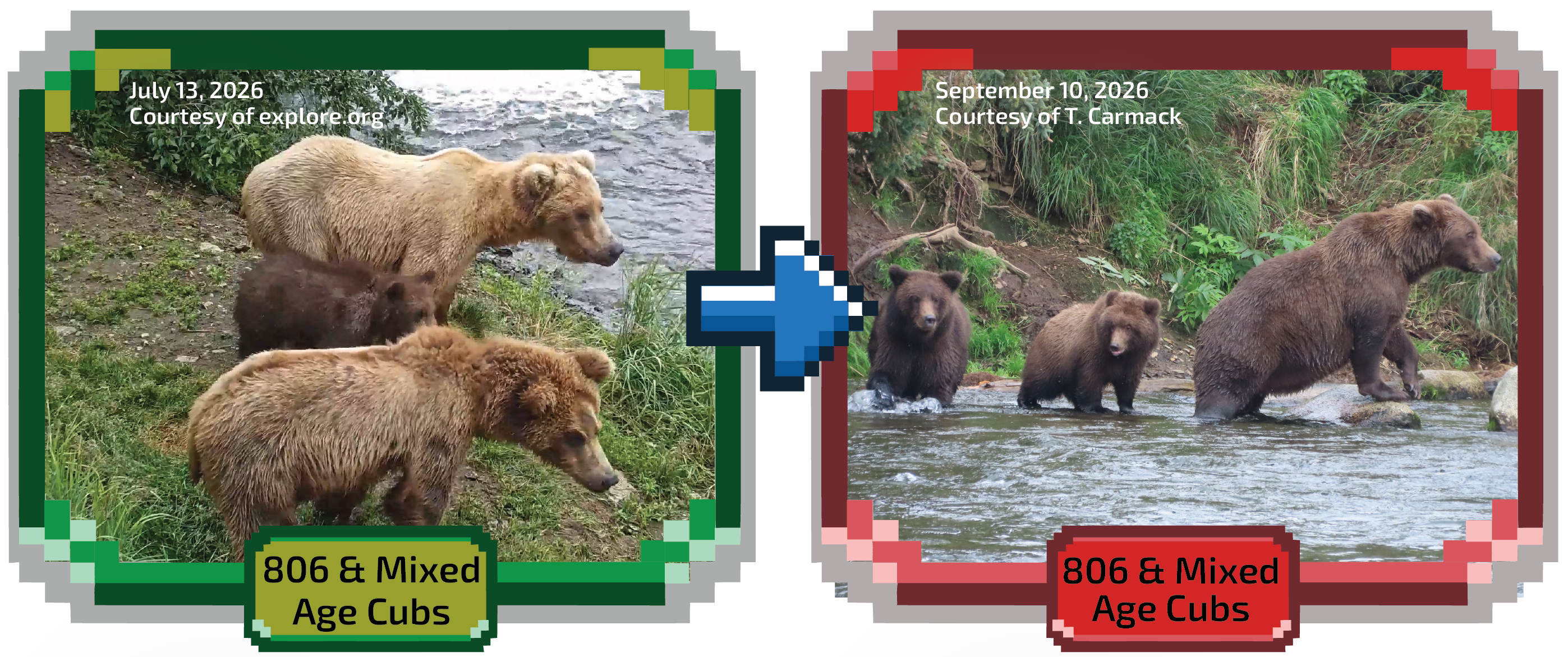
806, Her Biological Spring Cub, and Her Adopted 2.5-Year-Old Cub
Identification
This mother has round blond-tipped ears and grizzled brown fur. In early summer, she can have a short mane of longer fur around her head and face.
Biography
Bear 806 was first identified as a 3.5-year-old bear in 2019. She’s had three known litters, though her current litter is perhaps the most unique. It includes a single spring cub and an adopted 2.5-year-old. The adopted cub, known as Biggie, separated from her mother, 128 Grazer, in late spring. No one witnessed the first contact between Biggie and 806, but the adopted cub was the bear who likely took the risk to approach her new family. The blended family shows 806’s behavioral flexibility and willingness to extend her devotion beyond her biological cub.
806’s caring nature does have limits. On July 28, 806 attacked, killed, and partly ate bear 909’s spring cub. The cub swam across the river while her mother fished in the river mouth. This placed her near the 806 family and sparked their curiosity. After a few minutes the cub ran from the family, perhaps due to confusion about her own mother’s location or to escape to the safety of nearby trees. This triggered 806 to chase.
806’s attack on 909’s cub might seem incongruous with her adoption of Biggie just a few weeks before. The adoption is evidence of 806’s devotion and her behavioral flexibility. The fatal attack illustrates her ferocity and predatory instincts. But these behaviors are not mutually exclusive. Variations of them exist in all mother bears. They are honed through learned experience and initiated by circumstance. 806 is neither villain nor hero. She’s a bear, one who is fully capable of expressing great ferocity at the same time she is devoted and caring. This is her first Fat Bear Week appearance.
Watch to learn more about 806.
901 and Spring Cub
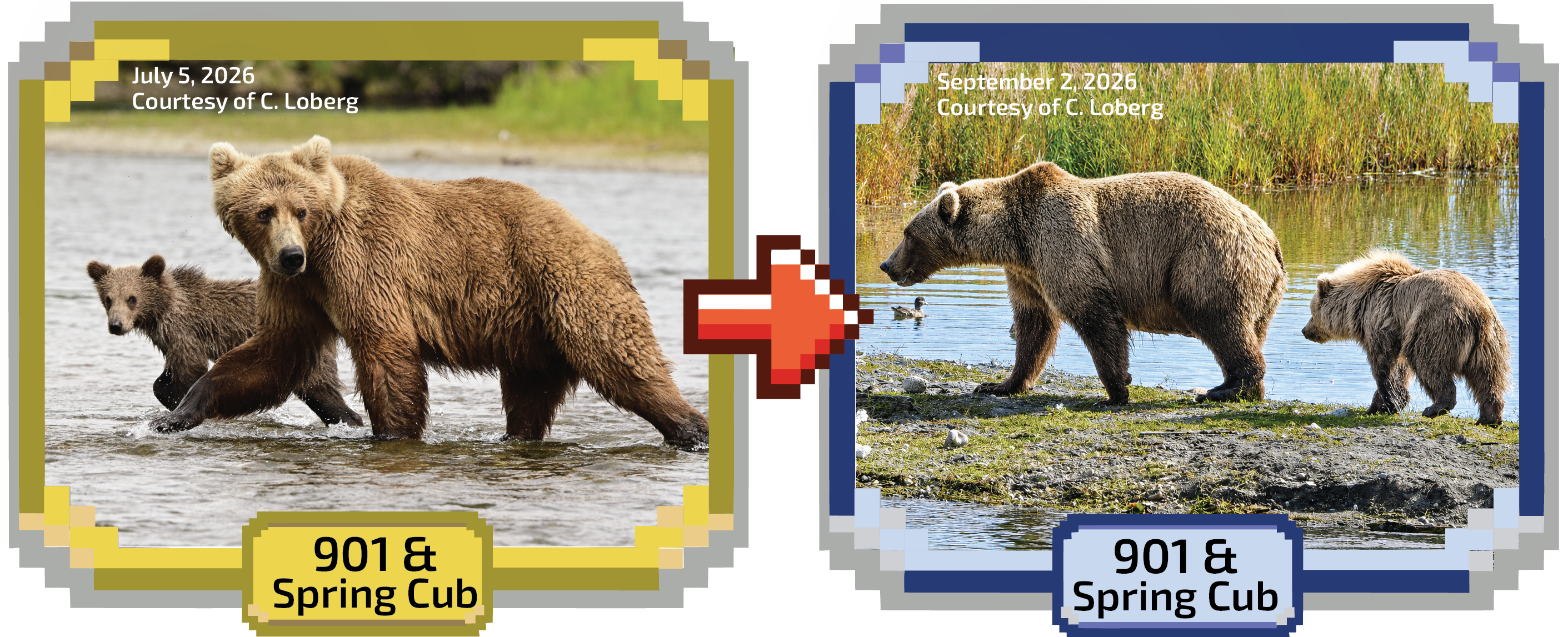
Identification
This mother is a medium-sized adult female who has blond-rimmed and triangle-shaped ears. Her fur is golden brown in early summer and grizzled brown in late summer.
Biography
Bear 901 was first identified as a 2.5-year-old subadult in 2018. She has since become one of the most prominent and recognizable female bears at Brooks River. She’s a common sight around the river mouth and in the vicinity of the campground, lodge, and national park visitor center.
Her adult life is marked by growth and sudden change. 901 readily achieves a level of fatness above that of many other bears, so she’s well positioned to survive winter and support the growth of her cubs. Yet, she has experienced mixed results while raising cubs. No cubs from her first litter survived. One of her two cubs in 2026 disappeared in June.
Since then, 901’s parental efforts have demonstrated her ability to work through loss. She knows the river well. She is a good angler. Her surviving cub has grown to become one of the largest at the river this year. Sudden loss and change have been part of 901’s life so far, but we also see her success reflected in her body size and the health of her cub.
Subadults
Subadult bears are independent juvenile bears generally between three and five years old. Like adolescent humans, a subadult bear often looks like they experience uneven growth spurts, giving them lanky legs and a disproportionately large head and ears. Behaviorally, this age class can be recognized by their playful and inquisitive nature.
Subadulthood is a time of significant change. These bears grow rapidly and learn to apply their survival skills without a mother’s guidance. Male subadults often disperse away from their mother’s home range, while female subadults frequently establish a home range that overlaps with their mother’s.
Because of their small body size, subadult bears rank low in the hierarchy at Brooks River, but they can also make a living more easily on vegetation than larger adults. The challenge for subadult bears is less about knowing which foods to eat and more about discovering when and where to get it. They also learn to compensate for the competition brought by larger adult bears. A subadult bear’s journey is one of exploration, uncertainty, and possibility.
620
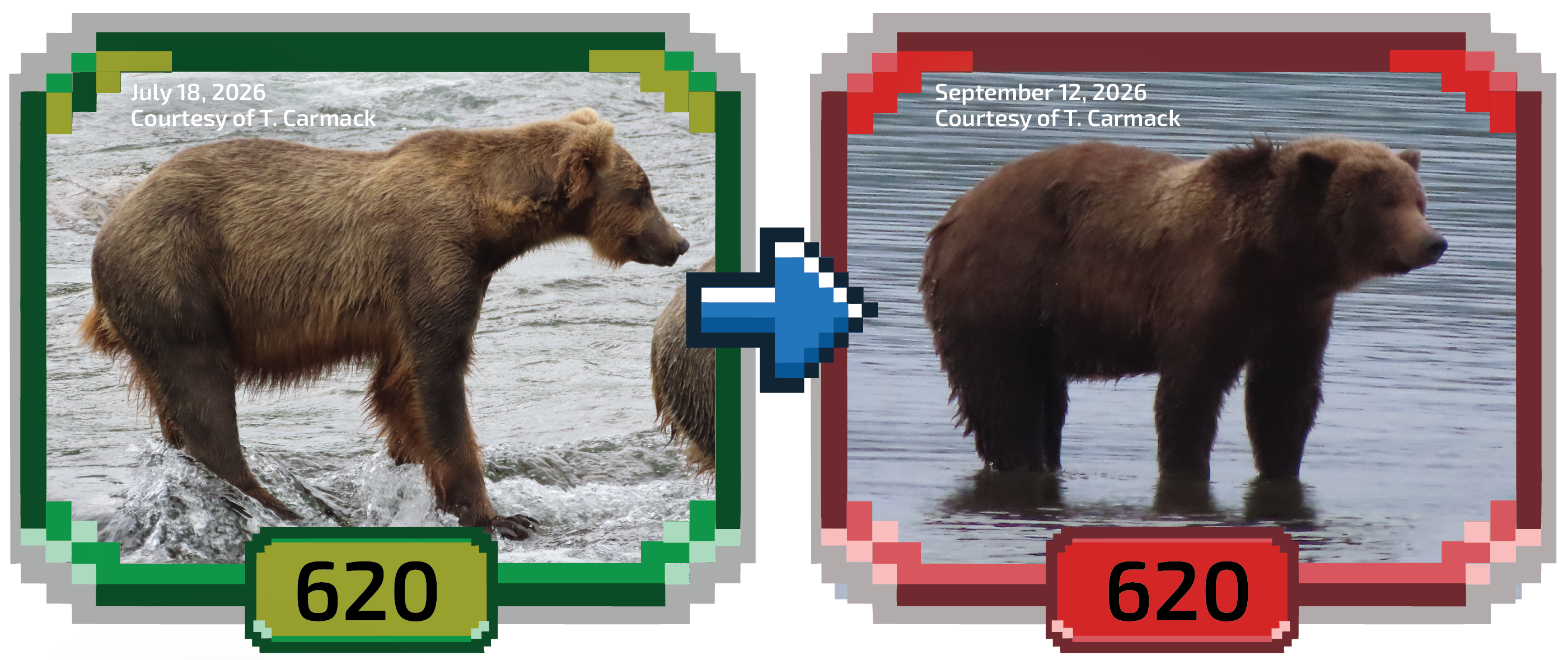
Identification
This female subadult bear has a long tail and light brown fur that becomes grizzled brown by late summer.
Biography
Bear 620 is on the cusp of adulthood and was first introduced to Brooks River as a spring cub in 2022. Her early life was filled with opportunities for socialization and learning. In an event only rarely documented among brown bears, 620’s mother, 910, and aunt, 909, bonded their families together in summer 2022. Each mother had a single cub, and between early August and late October, they largely traveled, fished, and played as a group. The next year, 910 and 620 adopted 909’s cub into their family.
When 910 separated from her cubs in spring 2025, it marked a new chapter in 620’s life. How will 620 use her experience and skills to strike her own path forward? Familiarity with Brooks River and knowing how to share space with her large mother and aunt may prove to be key to 620’s survival, longevity, and success.
694
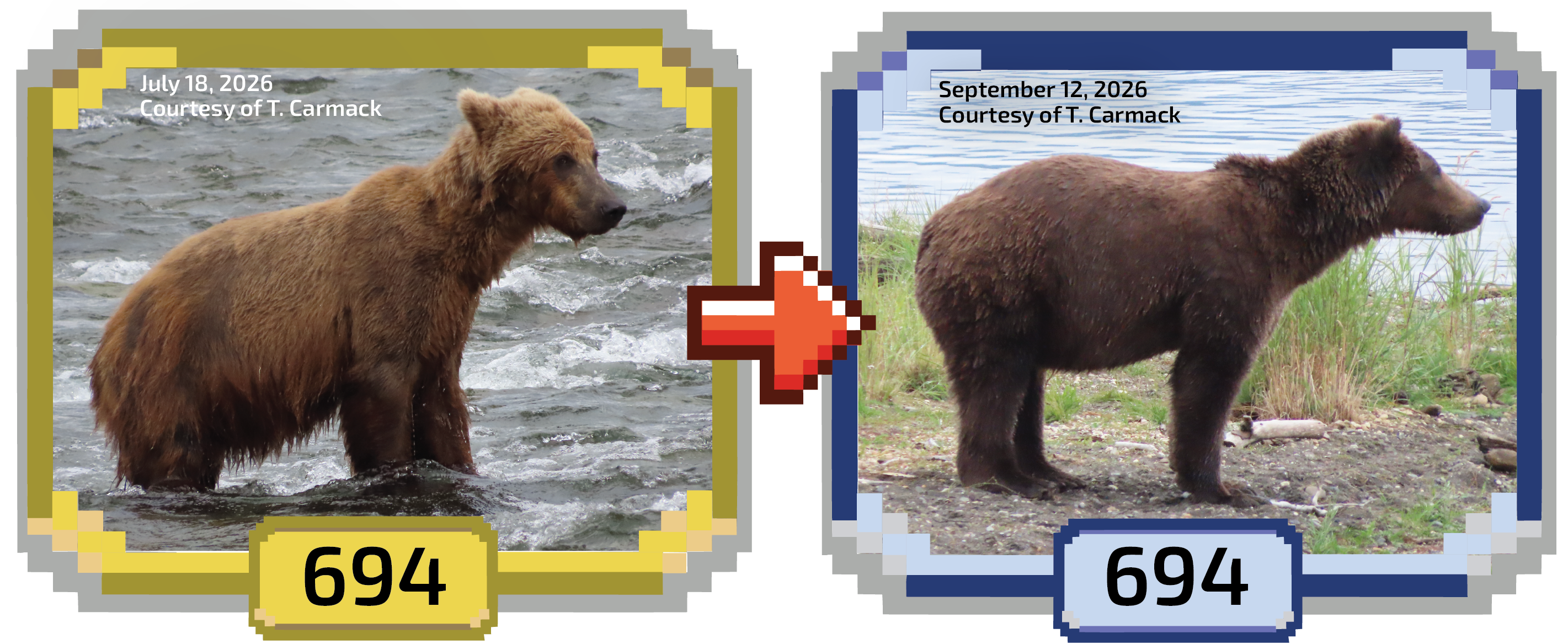
Identification
This male subadult has round ears placed high on his head and uniformly brown fur with hints of a remnant natal collar (a ring of lighter colored fur) near his neck.
Biography
Bear 694 is on a journey of discovery. He was born in 2022 and first identified as an independent bear in 2025. As a cub, 694 and his siblings tailed their mother throughout much of Brooks River, though the family mostly avoided visiting Brooks Falls. He might now realize the lucrative fishing opportunities available at the falls. He’ll investigate that area of the river and often catches salmon in the riffles immediately downstream, yet he is still too small to compete with the larger bears who prefer to fish there.
He frequently makes time to socialize with other bears, especially other subadults of similar age. Play doesn’t always take precedence over food for 694. He sometimes breaks a play session short to look for a salmon that captures his attention.
A brown bear’s survival is never guaranteed, especially for young bears like 694 who work to satisfy their hunger while facing considerable competition from larger bears. We don’t know whether 694 will ultimately choose to make Brooks Falls one of his preferred fishing locations. Even so, his work to socialize and discover new opportunities may position him to find much success as an adult.
Single Adult Females
Female brown bears alternate between a solo life and the responsibilities of parenting. Without cubs in tow, single female bears are afforded more independence in their movements and decisions. For example, they might be more willing to fish in places with high concentrations of bears, such as Brooks Falls.
A bachelorette’s life affords single female bears with the opportunity to concentrate on their own needs. The possibility of cubs in the future looms large for each female, though. Pregnant female bears need ample fat reserves before they enter the den if they are to give birth in mid-winter. Single female bears experience a freedom that prepares them for the changes and challenges that they could experience next summer and beyond.
131 Marshmallow
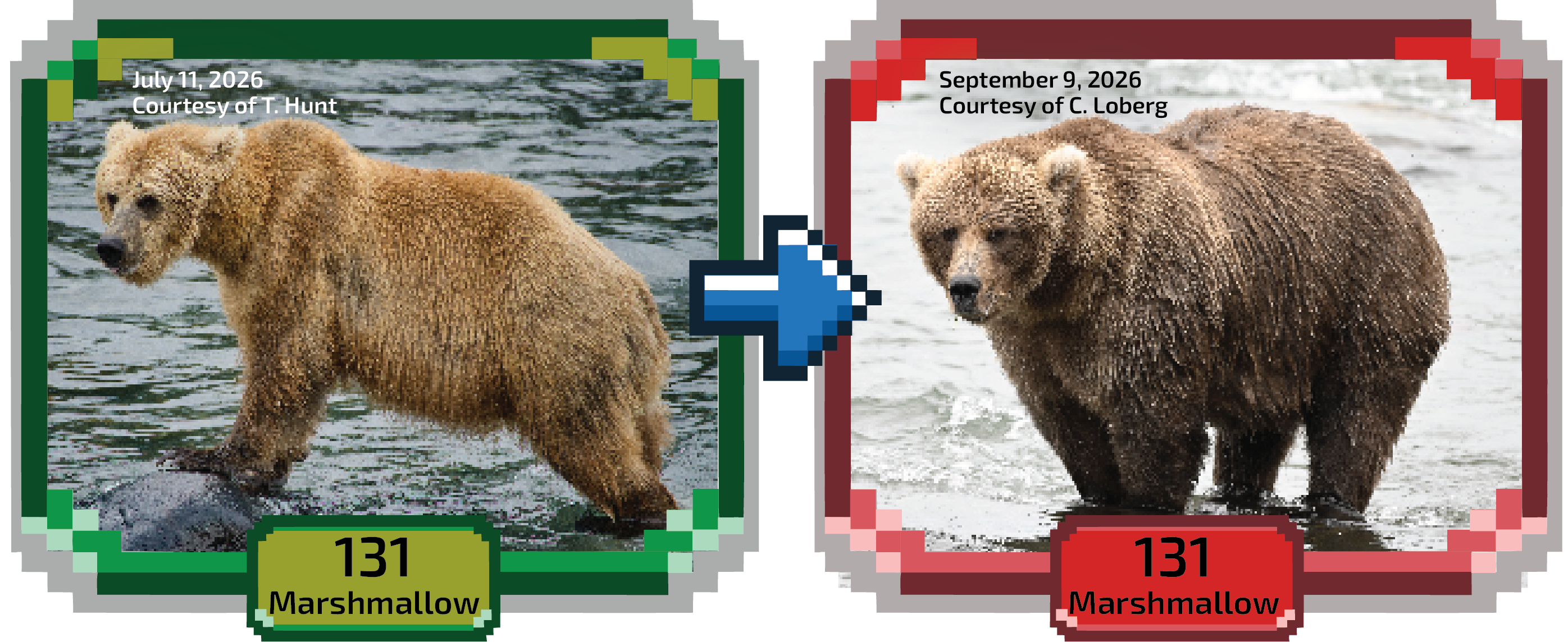
Identification
This bear has blond ears, dark eye rings, a short muzzle, and light brown to blond fur that turns grizzled brown by late summer.
Biography
Bear 131 was born in 2018 and first identified as an independent 2.5-year-old in 2020. Her first years of independence were typical of many subadults. She explored her boundaries, established a home range, sought out playmates with similar-aged bears, and refined her fishing skills.
A maturing adult, 131 is at an age when female bears give birth for the first time. She’s never been observed with cubs, which isn’t surprising. Reproduction in brown bears is slow, even when all of the necessary circumstances line up. With each year, however, 131 has grown larger and her fishing skills have improved. She appears this September to be proportionally fatter than she has ever been. Cubs could be in 131’s near future. Her growth both in size and maturity positions her well for the challenges ahead.
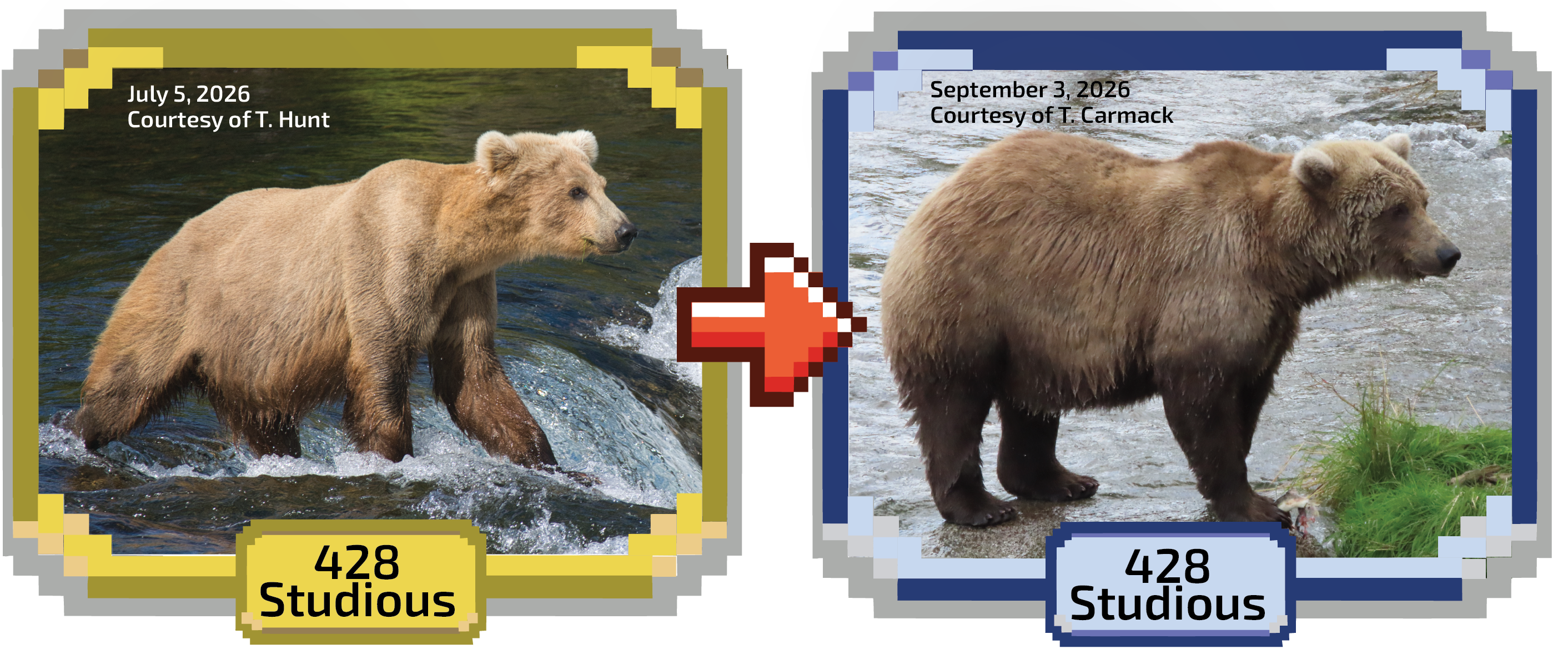
428 Studious
Identification
This small adult female has a short-pointed muzzle, blond ears, and grizzled blond fur in late summer.
Biography
Bear 428 was born in 2020 and first identified as an independent 3.5-year-old in 2023. As the daughter of the famously defensive and former Fat Bear Week champ, 128 Grazer, 428 had access to prime fishing spots at Brooks Falls that are unavailable to most cubs. As a yearling and 2.5-year-old, 428 followed her mother’s lead. She fished the lip of the falls, where younger bears are often displaced. Many bearcam fans refer to 428 by the nickname Studious because of her focused attention when she joined her mother fishing on the lip of Brooks Falls.
She’s already an excellent angler on the lip of the falls. One of her biggest hurdles is competition from other bears. To compensate, she takes advantage of her opportunities, either on the lip when space is available or by seeking salmon elsewhere. Several years after her apprenticeship ended with Grazer, how might 428 navigate the changes and challenges she’ll face as a maturing adult? The evidence so far suggests that Studious has a promising future.
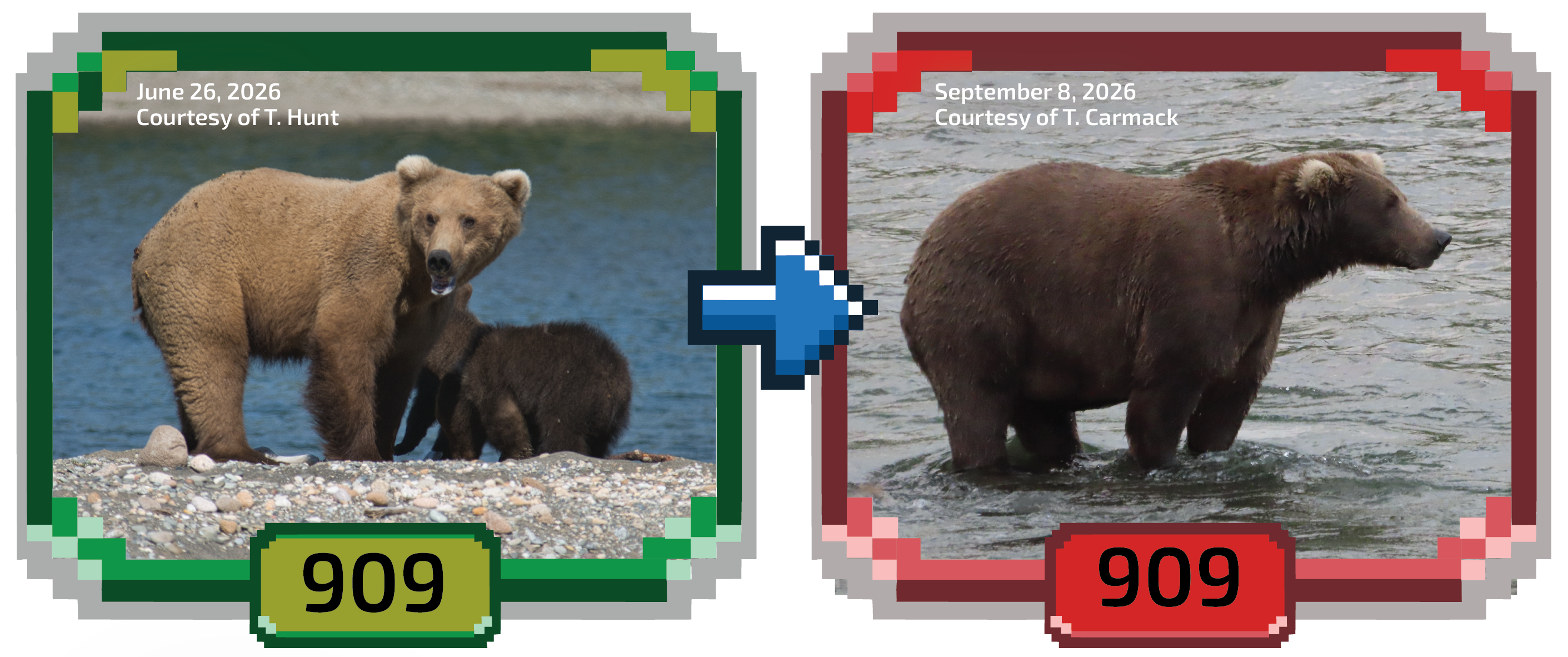
909
Identification
This is a large adult female who has brown late summer fur and wide set, blond ears.
Biography
Born in 2016, bear 909 is the daughter of former Fat Bear Week champion, 409 Beadnose, and sister to 910. Her year began with the hope represented in her newborn cubs, became mired by the complete loss of her litter, and has since been bookended by a display of resilience.
She arrived at Brooks River in early June with two spring cubs who represented her second known litter. One cub disappeared by the time the first pulses of salmon arrived. Further tragedy struck 909 at the end of July when her last cub was killed by another mother bear as 909 fished in the mouth of Brooks River (see 806’s biography for more information).
Mother bears react in myriad ways to the loss of cubs. Whether they mourn or feel any sense of sadness is unknown. With each passing day bringing winter ever closer, however, 909’s behavior showed that she remained motivated to prepare for hibernation. She displayed her resilience in the face of loss by navigating the rest of the summer with determination and skill. The effort is reflected in her plentiful body fat.
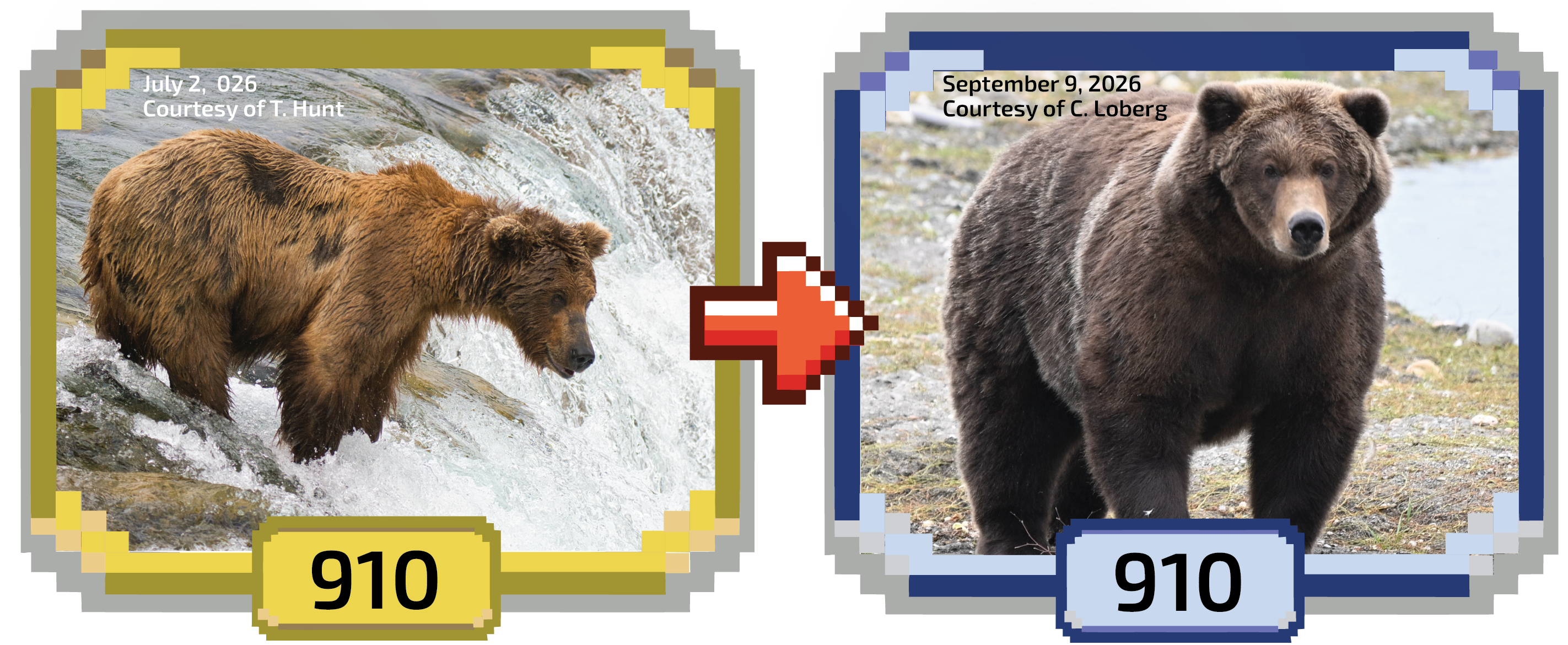
910
Identification
This is a large adult female who has dark brown fur, a prominent brow ridge, and somewhat short forward-pointing ears.
Biography
Born in 2016, bear 910 is the daughter of former Fat Bear Week champion, 409 Beadnose, and sister to 909. Her close relationship with her sister helped the 909 and 910 families bond in summer 2022. The following year, 910 adopted her niece, 609, into her family as she continued to raise her biological cub, 620.
910 separated from that litter in late spring 2025. Since then, she’s lived alone and has used the opportunity to fish where and when she wants. She can fish successfully throughout much of the river including the lip of Brooks Falls. She can be recognized there by her peculiar and frequent head lifts, a quirk of movement that she does not do anywhere else.
Large and apparently healthy female bears like 910 attract the desires of many males during the brief bear mating season. Other Fat Bear Week bears such as 151 Walker and 164 Bucky courted 910 in early summer. Body fat is vital to the ability of female bears to nurse their newborn cubs after giving birth in mid-winter. 910 looks well-endowed to endure that effort if she gives birth again. Her previous experience, success, and her skills in building fat place 910 in a position to achieve even more in life.
Adult Males
To earn dominance, sire cubs during a short mating season, and build enough fat to survive a long winter without food, a male brown bear faces many challenges. The bear who succeeds is the bear who meets those challenges.
Katmai National Park is home to some of Earth’s largest brown bears. Brooks River’s adult male bears can stand 3 – 5 feet (0.9 – 1.5 meters) at the shoulder and average 700 – 900 pounds (317 – 408 kg) in mid-summer. By late summer and fall, the biggest males often weigh more than 1,200 pounds (544 kg).
Because full grown males are the largest bears at Brooks River, they often dominate access to the most productive fishing spots at Brooks Falls. Adult males do not help raise cubs, so their reproductive success hinges on their ability to sire cubs. Competition, whether for fishing spots or for mating opportunities, may have driven the evolution of large body size in male bears. Their size, strength, and power exert great influence on behavior of other bears.
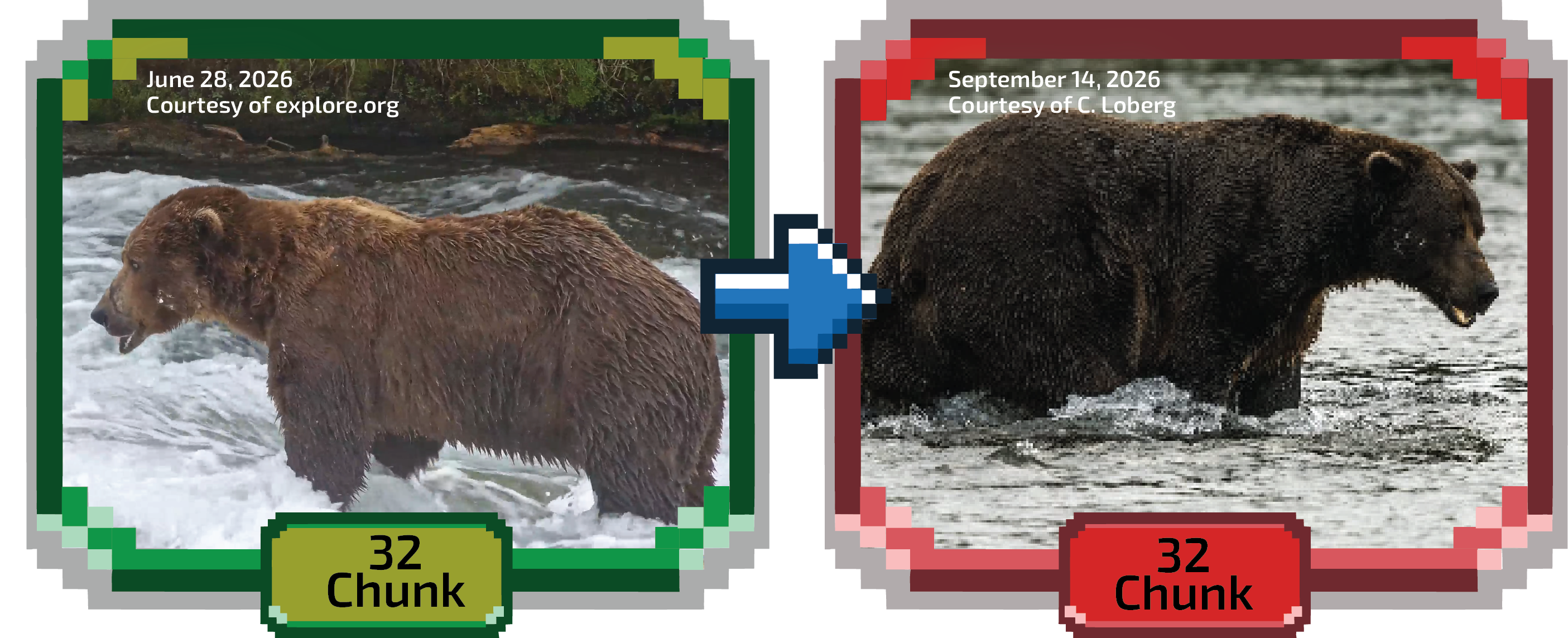
32 Chunk
Identification
This is a large adult male who has a large distinctive scar on his muzzle and a protruding canine tooth from a broken jaw suffered in 2025.
Biography
Chunk was first identified as an independent and chunky-looking 2.5-year-old in 2007. He grew into his nickname as a young adult and is now one of the largest bears at the river. Chunk broke his jaw in June 2025. No person observed how he was injured, but the nature of the fracture strongly suggests that the injury is the result of a fight with another bear.
This was perhaps the most serious injury Chunk had ever experienced. We watched him adapt and recover in real time. Chunk knew his strengths and recognized his weaknesses. His body size alone ensured a high rank in the hierarchy and good access to productive fishing spots. The 2025 salmon run was exceptionally abundant in Brooks River too, giving him ample opportunity to satisfy his hunger with ease.
His story this summer is mostly unknown. Chunk made few appearances at Brooks River before September. His low hanging belly is evidence that he was eating well, but we don’t know where he made his living before his recent return. Although Chunk’s absence for most of the summer leaves us asking many questions, his body size confirms that he used his determination and adaptability to persevere and succeed. He is the defending Fat Bear Week champion.
Watch to learn more about 32 Chunk.
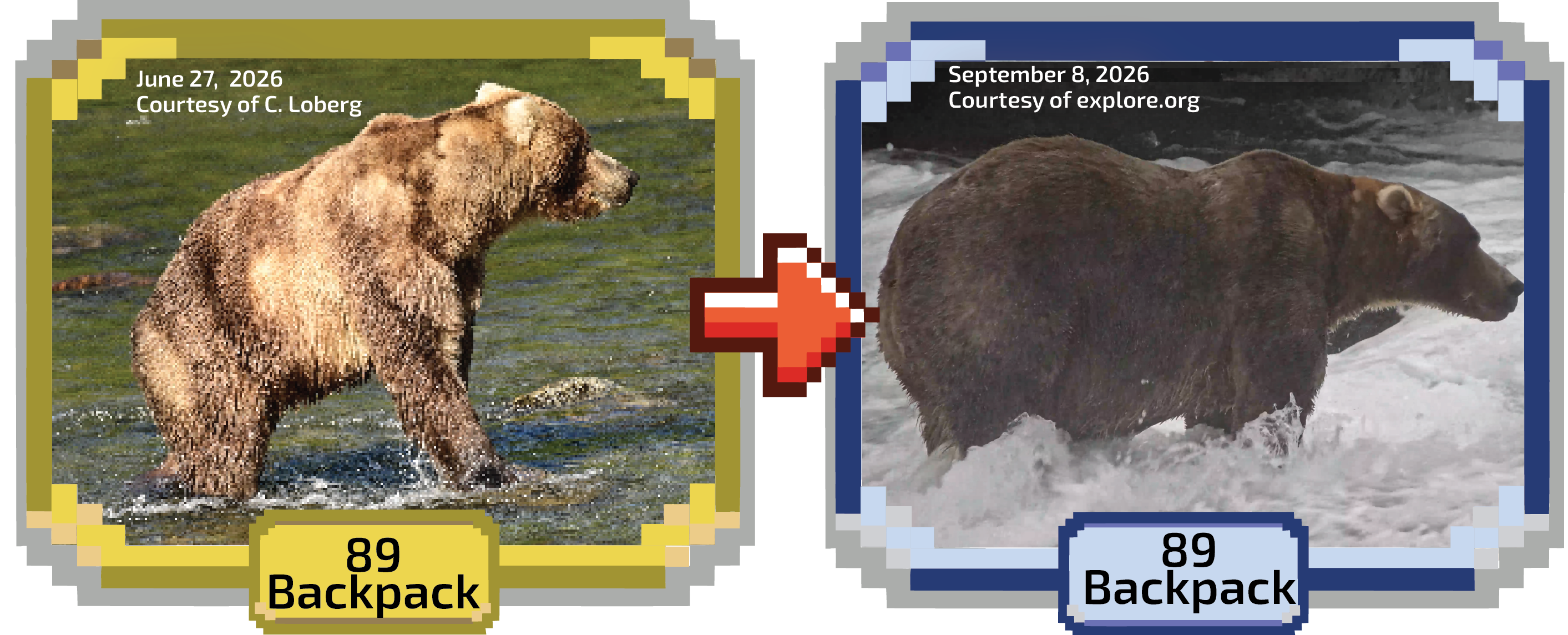
89 Backpack
Identification
This is a medium-large adult male with blond ears, light brown fur in early summer, and grizzled brown fur in late summer. He has relatively few visible wounds and scars compared to most adult males in his size and age class.
Biography
Backpack’s mother and former Fat Bear Week champion, Holly, introduced him to Brooks River when he was a first-year cub in 2006. Backpack often climbed onto his mother’s back when the pair swam in the river, a habit that inspired his nickname.
He returned with a significant leg injury in 2007. No person witnessed how Backpack was injured, though he clearly favored the injured leg and did not put weight on it for much of the summer. Park staff and the visiting public openly wondered about his chances of survival. Backpack soon proved he only needed the chance to let his mother care for him and recover on his own. His leg healed and he separated from his mom in 2008. Since then, Backpack has grown into a large adult and become a consistent presence at Brooks Falls, especially in early summer.
Unlike many large adult male bears, Backpack hasn’t shown much aggression toward his competitors. He’ll stand up for himself when necessary, but he prefers to use a quiet strength to gain access to preferred fishing spots. His body size suggests that the strategy works. Although some bears are brawlers who thrive in the face of competition, others find a way to live within calmer niches. These bears, like Backpack, express their own versions of toughness, yet are no less successful than their more aggressive counterparts. Backpack’s quiet toughness has allowed him to find his niche alongside the biggest bears at Brooks River.
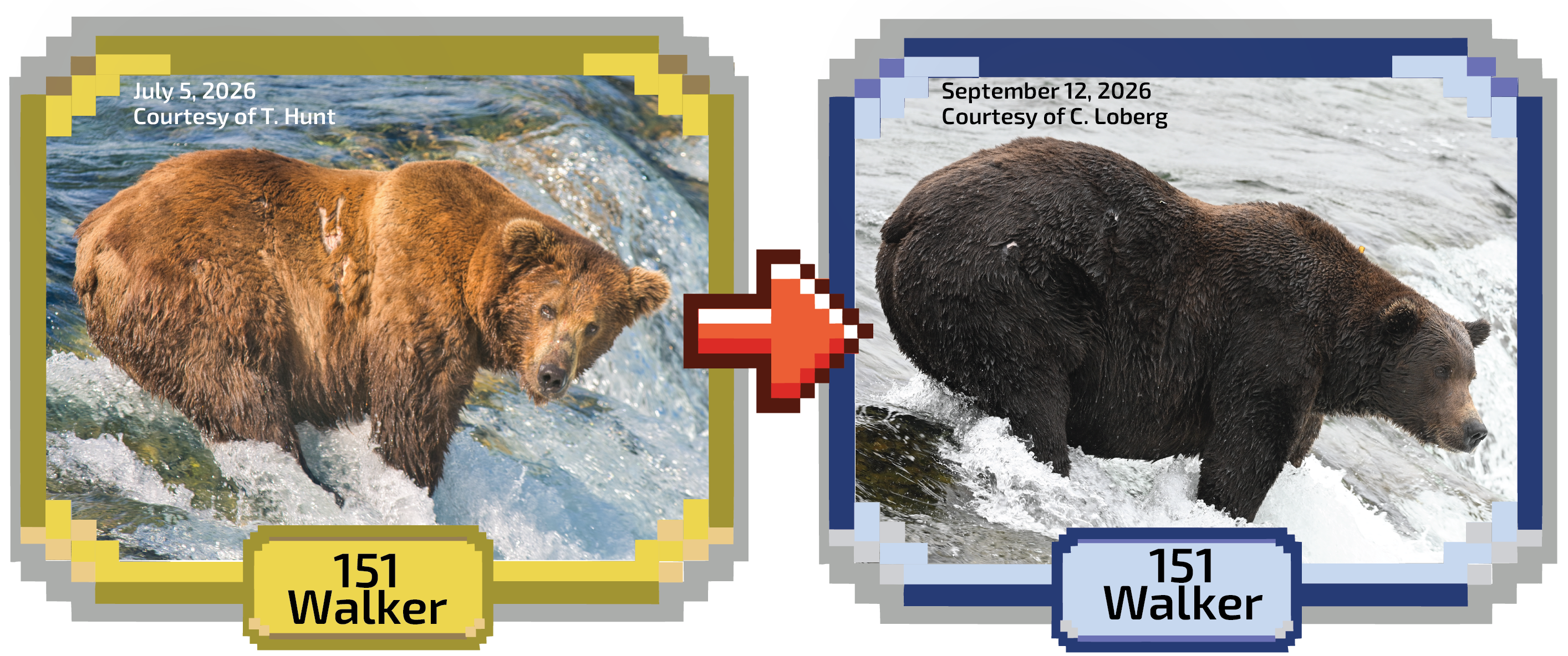
151 Walker
Identification
This is a large adult male with dark brown fur, a pear-shaped body, a long muzzle, and large round ears.
Biography
As a young, independent bear, Walker seemed to enjoy the company of other bears. He sought opportunities to play and was good at motivating other bears to join him. You could’ve concluded that Walker was easy going. You would’ve been right. Fast forward to 2026, though, and Walker is a different bear.
Currently, he’s much more willing to challenge other bears than engage them in play. He experiences pushback, too. Walker now faces a challenging lineup of younger adult males who want the same things as him. Walker’s size and experience has, so far, given him an advantage over most of those competitors, but that won’t last forever. In fact, his place in the hierarchy might already be at risk as younger bears, such as 164 Bucky, 903 Gully, and others, grow into the prime of their lives.
How much of a young bear’s personality remains with them into adulthood? Since some bears use Brooks River in Katmai National Park for their entire lives, we’re given a chance to find some answers. Just like in people, the behavior of a youthful bear is not the same as that in an older adult. Walker provides a clear example of change alongside maturity.
Watch to learn more about 151 Walker.
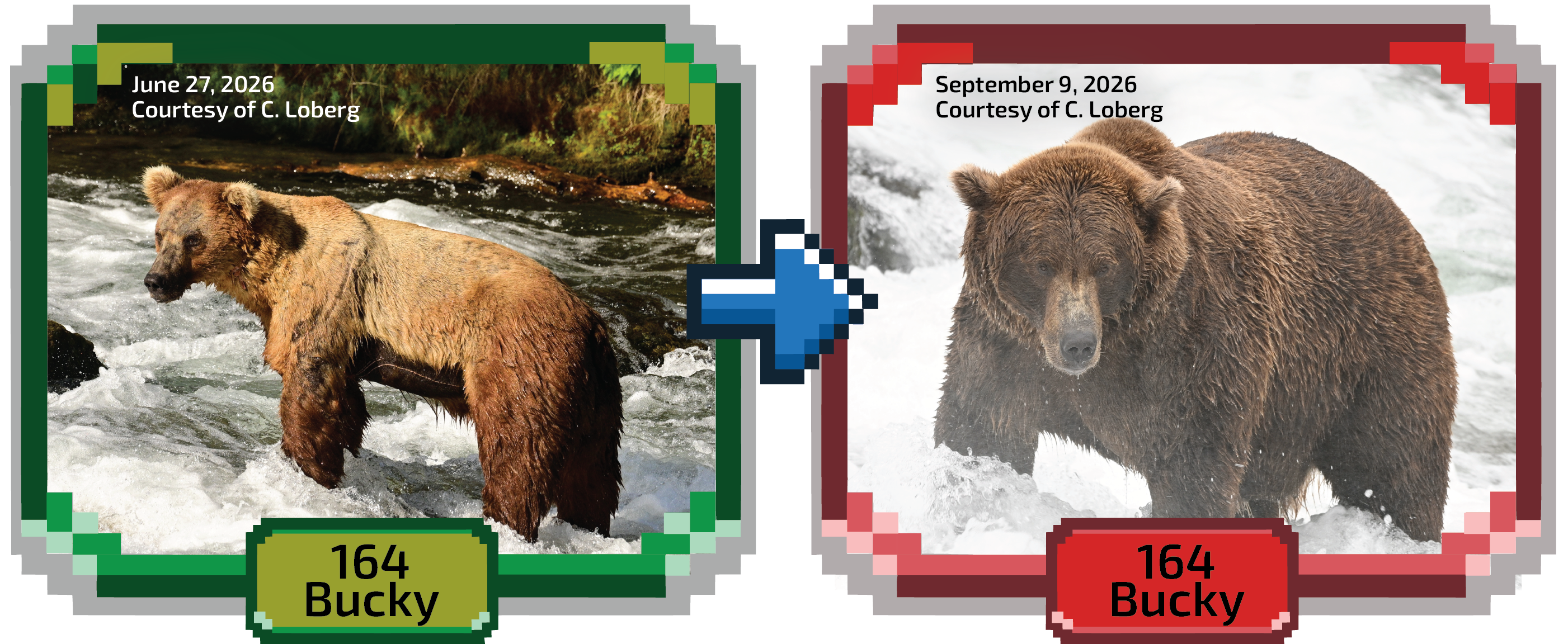
164 Bucky
Identification
This is a large adult male who has grizzled brown fur and blond-tipped ears tipped. Many observers identify him by a line of darker fur near his eyes on his upper muzzle.
Biography
Bucky was first identified as an independent 2.5-year-old in 2019. Young male bears are inclined to test their boundaries. For Bucky, testing your boundaries means adapting to competition and embracing opportunity.
Productive fishing spots are often limited at Brooks Falls, especially for young bears. Standing at the edge of the deepest plunge pool, nearly under the cascade of Brooks Falls, Bucky discovered that he could catch salmon in a few ways. He could capture them welling up from the pool below, jumping through the air, and falling from above. This is a spot that no other bear—currently or in the recent past—has tried to fish at consistently.
Large amounts of food allow bears to grow fast, and Bucky has grown a lot during the last few years. A change in attitude accompanied his increase in size. Bucky is able—and often willing—to displace most other bears from preferred fishing spots. Bucky has also shown a tendency to challenge other bears for dominance, even when no fishing spot is in dispute. Male brown bears in Katmai usually reach the peak of their size and strength when they are about 12 – 20 years old. Bucky is estimated to be only 9 years old in 2026, so he could grow even larger and more dominant. Since making his presence known at Brooks River, Bucky seized the opportunities in front of him. We have yet to see how far those opportunities will take him.
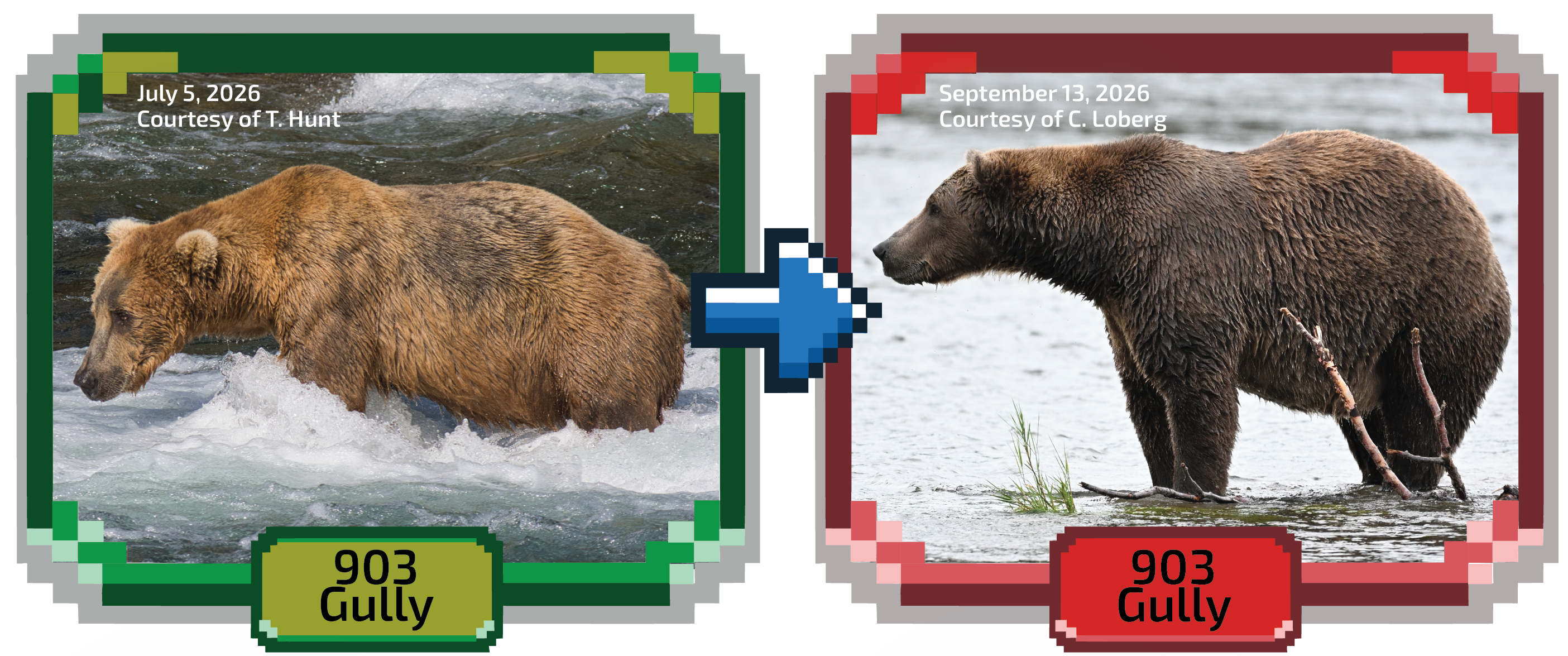
903 Gully
Identification
This is a medium-large adult male with grizzled brown fur and a long straight muzzle. In early summer, he is often identifiable by his Eeyore-like sitting position on the lip of Brooks Falls.
Biography
Bear 903 was born in 2016 and is believed to be the son of former Fat Bear Week champion 128 Grazer. A cub’s life with Grazer can be hectic as Grazer doesn’t avoid bringing her cubs to places with high concentrations of bears, such as Brooks Falls. Gully’s introduction to Brooks River gave him an early opportunity to experience the rewards and risks present at Brooks Falls.
Maybe those experiences also gave 903 the confidence to try new things. During 2020, amidst one of the largest salmon runs ever observed at Brooks River, Gully decided that birds should also be on the menu. Unlike most of the river’s brown bears who ignore birds, Gully would charge into resting or feeding flocks of gulls to capture and eat them. This behavior inspired his nickname.
He’s since become large enough to vie for access to the most productive fishing spots at Brooks Falls. Gully is now more dominant than some older bears like 151 Walker. Maybe he won’t need to hunt birds in the future, but we’re likely to see him display his adaptability and skill to find success among some challenging competition.