Bear cubs experience many challenges, and their vulnerability is often magnified by their small body size. Cubs are born in midwinter and only newborn cubs suckle mother’s milk in the den. All others rely on their fat reserves to survive winter hibernation. To prepare for the months-long fast, cubs gain body mass at proportionately greater rates than even the largest adult bears. A spring (first-year) cub weighs about one pound (0.45 kg) at birth yet may begin hibernation weighing more than 70 pounds (32 kg). By the end of their second summer, yearling cubs in Katmai commonly weigh more than 200 pounds (91 kg).
Brown bear families in Katmai National Park typically separate at the beginning of a cub’s third or fourth summer. Life with mom is a short apprenticeship, and cubs must absorb mom’s lessons if they are to survive as independent bears.
Some cubs in Fat Bear Junior 2022 are competing solo while others are competing alongside their littermates.

94’s Triplet Spring Cubs
Identification
These first-year cubs vary in size and fur color. Two are near equal size and the other is larger. The largest has the lightest brown fur, while the two medium-sized cubs have classically brown fur. Each also has a natal collar of pale, grizzled brown fur around its neck.
Biography
Born last winter, bear 94’s cubs represent their mother’s fourth known litter. When the family arrived in early summer, mom was accompanied by four cubs. In mid September, however, the smallest cub was killed by another bear. A different cub was briefly separated during the attack. Successfully raising a litter of four cubs is especially challenging for mother bears, and no mother at Brooks River has ever weaned an entire litter of four cubs since record keeping began.
In Katmai National Park, the average litter size for a mother bear is 2 - 3 cubs. A litter of four is especially uncommon. Individual cubs from large litters are often smaller in size than cubs from smaller litters due to the increased competition between siblings for mother’s milk and other foods. In early and midsummer, each of these cubs might demand as much as 45 ounces of milk (about 1,331 mL) per day. Milk remains a vital part of their diet as they enter the final weeks before winter hibernation, although other foods like salmon are increasingly important to their growth. The surviving cubs in this litter remind us that the lives of young bears are filled with risk and even the most skilled mother bears can experience loss.
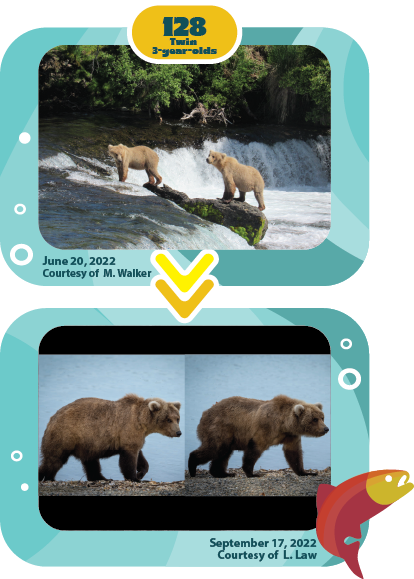
128 Grazer’s Twin Three-Year-Old Cubs
Identification
These siblings have light brown fur that is especially grizzled around their face and neck. Their ears are conspicuously blond.
Biography
You can be excused if you’d rather not call these twins “cubs.” Born in 2020, Grazer’s almost three-year-old bears have benefited greatly from their mother’s bold nature and the lessons she taught them. Along with mom, the twins frequently dominated access to the lip of Brooks Falls where they caught their own salmon in early summer. Knowing their mother’s protective tendencies, they sometimes approached larger bears with a confidence typically lacking in most independent bears of the same age. Although the twins remain at mom’s side this fall, they behave quite independently and catch their own fish more often than they scavenge mom’s leftovers. Next spring, they’ll likely separate from Grazer and transition to a life without her guidance or protection.

909’s Yearling
Identification
This almost two-year-old cub has a skinny neck, a large head, and medium-brown fur with grizzled tips.
Biography
909’s yearling frequently visited Brooks Falls in her second summer alongside mom. At first, she waited patiently for mom to catch the salmon needed to feed the family. By August, however, the yearling developed the skills and confidence to catch a few of her own salmon on the lip of the falls—a feat that yearling bears rarely accomplish. Her story also intertwines with her aunt, 910, and her cousin, 910’s spring cub. 909’s yearling plays frequently with her cousin and shows great restraint during the bouts, giving the smaller and younger spring cub the opportunity to enjoy the play-fights as much as she.
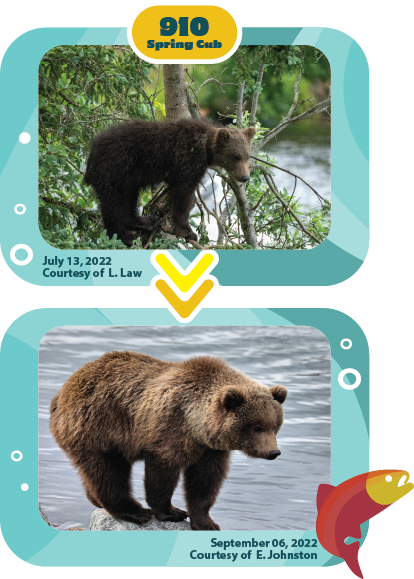
910’s Spring Cub
Identification
This first-year bear has a pointed muzzle and shaggy brown fur with grizzled tips on her neck, stomach, and flanks.
Biography
A cub to a first-time mother, 910’s spring cub faced a world of new experiences this year. She followed her mom to Brooks Falls for the first time, tasted freshly caught salmon for the first time, navigated a gauntlet of larger bears for the first time, and until arriving at Brooks River, had likely never played with another bear besides her mother. When mom fishes at the falls, she often sits patiently on the riverbank or climbs a tree where she can wait safely. Her life is far from solitary, though. She plays frequently with her cousin, 909’s yearling. Amiable relationships among young bears may translate into greater tolerance between those same bears as adults, especially related females. Might we expect that dynamic in her future if she and her older cousin return to the river in a few years as adult bears?