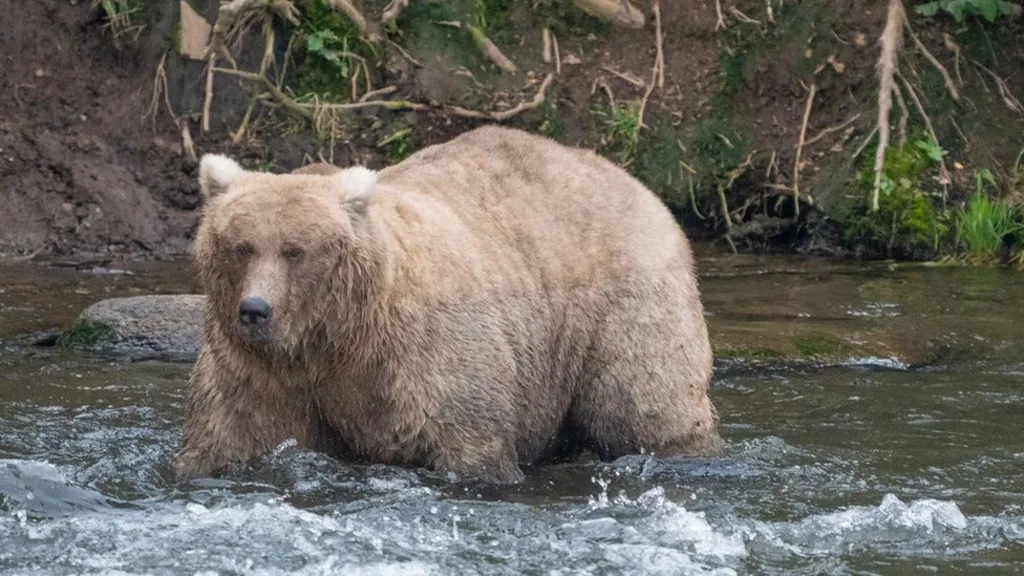
Vote for the fattest bear of the year! Some of the largest brown bears on Earth make their home at Brooks River in Katmai National Park, Alaska. Brown bears get fat to survive. Fat Bear Week is an annual tournament celebrating their success in preparation for winter hibernation. Matchups are open for voting September 22 - 29 between 12 - 9 p.m. Eastern / 9 a.m. - 6 p.m. Pacific / 8 a.m. - 5 p.m. Alaska.
This is a single elimination tournament. For each match-up, vote for the bear you believe best exemplifies fatness and success in brown bears. The bear with the most votes advances to the next round. Only one will be crowned Fat Bear Week champion.
Meet the bears, download and fill out your bracket, predict your fat bear winner, and campaign for your candidate.

Scroll to see Both matches!
How to Participate:
Start by entering your email on the line above each poll. View the before and after photos. Scroll down to select which bear you think is fattest. A box will appear around the bear you chose. Click “submit”.
You’ll see a confirmation message. Click “See Previous Responses” to see results. Repeat these steps through all the polls until finished.
Vote between 12 - 9 p.m. Eastern / 9 a.m. - 6 p.m. Pacific
Poll 1
Having issues voting? Go directly to the voting form.
Poll 2
Having issues voting? Go directly to the voting form.
Meet the Bears of Fat Bear Week
Brown bears survive by using their adaptability when circumstances change, remaining resilient when situations become difficult, following their instincts, and relying on their intelligence when facing new challenges.
Get to know the bears of Fat Bear Week on our Meet the Bears page and learn about how they survive in the wildlands of Katmai National Park, Alaska, home to some of the last great runs of salmon on earth.
Who should I vote for?
Although getting fat enough to survive winter hibernation is the goal, success for Katmai National Park’s brown bears is measured in many ways. How did the bears overcome the challenges that they faced this summer? How might their hard work lead to their success next year? How big did they really get?
Mother bears need ample body fat to survive hibernation, but they also must feed, nurture, and protect their cubs. Single adult females get fat in preparation to give birth to cubs in mid winter and nurse them without eating until they exit the den in spring. Older bears get fat while trying to compete with younger bears for preferred fishing spots. Large adult male bears maintain their high rank in the hierarchy by challenging competitors. Cubs and subadult (teenage) bears grow proportionally more each year than even the biggest adults, while they learn the skills to survive. In short, Fat Bear Week is a subjective competition. Learn more about the Fat Bear Week bears, download an fill out your bracket, and campaign for your favorite candidate using #FatBearWeek on social media.
Why are fat bears important?
Katmai’s brown bears are fattest in late summer and early fall. It is the result of a summer-long effort to satisfy their profound hunger and prepare for winter hibernation. During hibernation, bears do not eat or drink and lose one-third of their body weight. Their winter survival depends on accumulating ample fat reserves before entering the den.
To get fat, bears gorge on the richest and most accessible foods they can find. In Katmai National Park that often means salmon. Dozens of bears gather at Brooks River to feast on salmon from late June until mid October. Perhaps no other river on Earth offers bears the chance to feed on salmon at one place for so long.
Fat bears are successful bears. They exemplify the richness of Katmai National Park and Bristol Bay, Alaska, a wild region that is home to more brown bears than people and the largest, healthiest runs of sockeye salmon left on the planet.
Results
| Date | Matchups & Results | |
| September 23 | 132 family: 171,619 284 family: 46,449 |
806 family: 135,510 901 family: 74,679 |
| 909: 155,899 428 Studious: 51,493 |
131: 84,145 910: 98,126 |
|
| September 24 |
694: 17,589 |
610 Family: 20,635 89 Backpack: 140,140 |
|
32 Chunk: 46,053 |
151 Walker: 134,153 903 Gully: 31,087 |
|
| September 25 |
132 Family: 75,035 |
620: 6,173 89 Backpack: 123,416 |
| 909: 26,766 910: 104,545 |
151 Walker: 45,775 164 Bucky: 84,514 |
|
| September 26 |
No Voting |
|
| September 27 | No Voting |
|
| September 28 | ||
| September 29 |
Finals |
|
|
Total |
|
|

:focal(2560x1707:2561x1708)/https://tf-cmsv2-smithsonianmag-media.s3.amazonaws.com/filer_public/39/5a/395af9c9-82ec-40d2-8b94-d43ec9088f0e/gettyimages-1263017191.jpg)

/https://tf-cmsv2-smithsonianmag-media.s3.amazonaws.com/filer_public/67/6f/676f8fd5-488c-4a04-a51a-191b03a543d8/main_20140720_2z9b2050_edmackerrow_fullres_web.jpg)




Brought to you by